

… Say Project will Restore Lowland Forest Landscape
By Joy Ifekwe
The Edo State Government in collaboration with the Federal Government, the Food and Agriculture Organization (FAO) of the United Nations, and the Global Environment Facility (GEF7), has reaffirmed its commitment to biodiversity conservation and sustainable environmental management with the commissioning of critical infrastructure and interventions under the Biodiversity Conservation and Sustainable Use of the Lowland Forest Mosaic Landscape Project.
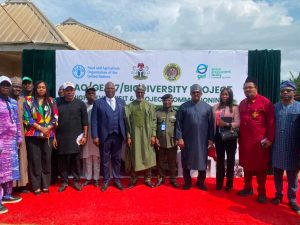
The commissioning ceremony, which held in Udo Community, Ovia South-West Local Government Area of Edo State, brought together government officials, development partners, environmental experts, traditional rulers, community representatives, and other stakeholders, who are committed to safeguarding Nigeria’s natural heritage and promoting sustainable environmental management.
The Edo State Governor, Sen. Monday Okpebholo, represented by the Commissioner for Environment and Sustainability, Hon. Nosa Adams Esq., described the project as a landmark intervention that demonstrates the collective resolve of government and development partners to address environmental challenges and protect biodiversity for future generations.
According to him, the initiative aligns with the State Government’s environmental sustainability agenda and reflects a shared commitment to tackling climate change, deforestation, flooding, erosion, and land degradation, which has continued to threaten livelihoods and ecosystems across the Country.
Sen. Okpebholo noted that the organizations involved in the project embodied partnership, collaboration, and shared responsibility, adding that the initiative would strengthen community participation through capacity-building programmes, technical training, and knowledge-sharing activities, aimed at equipping local stakeholders and youths with the skills needed for sustainable environmental management.
The Governor disclosed that the Edo State Government will continue to establish institutional frameworks for climate change adaptation and forestry management, emphasizing that the project represents a significant step toward building resilient ecosystems and improving the well-being of communities that depend on forest resources.
In his address, the Honourable Minister of Environment, Mallam Balarabe Abbas Lawal, commended the Edo State Government, FAO, and GEF7 for the successful implementation of the project and expressed satisfaction with the quality of infrastructure and interventions delivered under the programme.
The Minister noted that the facilities and equipment commissioned under the project reflect the commitment of the implementing partners to strengthening environmental governance and conservation efforts in Nigeria. He described the initiative as a model of effective collaboration between government institutions and international development partners.
Mallam Lawal disclosed that Nigeria is transitioning into the GEF-9 cycle, which will prioritize interventions in critical environmental sectors, including pollution control, flood management, coastal erosion mitigation, and land restoration. He emphasized the role of the media in raising environmental awareness and supporting government efforts toward environmental sanitation and public health.
The FAO Representative in Nigeria and ECOWAS, Dr. Hussein Gadain, expressed satisfaction with the progress recorded under the project and reaffirmed FAO’s commitment to supporting biodiversity conservation and sustainable livelihoods across the participating states. He highlighted the rehabilitation and renovation of operational facilities for the National Park Service as one of the Project’s key achievements, noting that critical equipment had also been procured and distributed to beneficiaries to enhance operational efficiency and strengthen conservation efforts within the Project landscape.
Dr. Gadain explained that the initiative would significantly improve livelihoods in host communities while supporting long-term environmental sustainability. He commended the Edo State Government and other stakeholders for their unwavering support and reiterated FAO’s commitment to sustaining project outcomes through continued collaboration with local communities.
Delivering the keynote address, the Conservator-General of the National Park Service, Dr. Ibrahim Goni, described the project as a major milestone in Nigeria’s efforts to conserve biodiversity, protect forest ecosystems, and enhance climate resilience. He stated that the Project aligns with national and global environmental conservation goals and demonstrates a strong commitment to safeguarding natural resources while promoting sustainable development in communities located within and around protected areas.
Dr. Goni emphasized the strategic importance of the Okomu landscape, describing Okomu National Park as one of Nigeria’s most valuable environmental assets and among the Country’s last remaining lowland rainforest ecosystems. He noted that the park plays a critical role in conserving endangered wildlife species, maintaining ecological balance, and regulating regional climate systems. He stated that despite its ecological significance, landscape continues to face increasing threats from unsustainable agricultural practices, habitat destruction, illegal exploitation of forest resources, and other forms of human encroachment.
The Conservator-General highlighted several achievements recorded under the project, including the construction and operationalization of administrative and field offices, deployment of biodiversity monitoring equipment, strengthening of anti-poaching operations, and implementation of community-focused interventions designed to promote sustainable environmental management.
He stressed that successful conservation efforts require the active participation of local communities and called for stronger partnerships among governments, development partners, traditional institutions, civil society organizations, and community leaders to address biodiversity loss, climate change, and land degradation.
Providing a technical overview of the project, the FAO-GEF7 Technical Advisor, Mr. Kayode Aboyeji, explained that the initiative was specifically designed to address growing threats to Nigeria’s forest ecosystems, biodiversity resources, and agro-ecological landscapes.
According to the FAO-GEF7 Technical Advisor, the Biodiversity Conservation and Sustainable Use of the Lowland Forest Mosaic Landscape Project is built around four key components: Integrated Landscape Planning and Management; Biodiversity Conservation and Restoration; Sustainable Practices and Livelihood Development; and Knowledge Management, Monitoring and Evaluation.
Mr. Aboyeji explained that the components are designed to strengthen environmental governance, promote sustainable land-use practices, restore degraded ecosystems, and enhance biodiversity conservation across the project states. He noted that the project adopts a community-driven approach that supports eco-friendly livelihood opportunities while reducing pressure on forest resources. The initiative also emphasizes reforestation, the establishment of specialized nurseries, capacity building, data collection, monitoring, and the exchange of environmental best practices to improve conservation outcomes and strengthen decision-making processes.
Highlighting the urgency of the intervention, the FAO-GEF7 Technical Advisor disclosed that Nigeria is home to more than 4,750 plant species, 173 mammal species, 203 reptile species, 285 amphibian species, and over 775 fish species, many of which are threatened by habitat loss, deforestation, overexploitation, and climate change. He expressed confidence that the project would contribute significantly to biodiversity conservation, forest restoration, climate resilience, sustainable livelihoods, and improved environmental governance across Edo, Ogun, Delta, and Ondo States.
Highpoint of the event was the commissioning of infrastructure and facilities delivered under the Biodiversity Conservation and Sustainable Use of the Lowland Forest Mosaic Landscape Project. Stakeholders expressed optimism that the initiative would strengthen conservation efforts, empower local communities, restore degraded ecosystems, and support Nigeria’s commitment to achieving national and international biodiversity conservation and sustainable development goals.